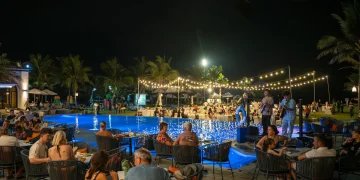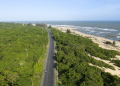

Although Hai Duong is not a prominent name on the tourist map, it attracts tourists with its long historic sites and peaceful and charming scenery.
Contents
What season to go to Hai Duong?
Hai Duong is suitable for visiting all four seasons of the year. However, the festival season from January to March is the most beautiful time because Hai Duong has many temples and historical sites. The lychee season in the harvest is from May to June. The sunflower season is in October. December is the blooming season of wild sunflowers. Visitors are free to check in with the flower road at Phu Tao bridge, Hai Duong City.

How to move to Hai Duong
Hai Duong is about 60 km from Hanoi. To Hai Duong, there are many means of transportation, such as personal cars, passenger cars, limousines, and trains.
The fastest is to ride a limousine with quick travel time, convenience, and spacious and comfortable seats. You can refer to the limousine at Di Chung, which costs 250,000 VND per ticket, runs continuously, and has a trip every 30 minutes. A cheaper option is the Tuan Hai limousine, a 16-seat car with four visits a day. In addition, you can choose to take a passenger car, refer to Phuc Xuyen, Dung Thuy, priced at 60,000-70,000 VND.
The experience is more exciting and leisurely than taking the train, returning to Phu Thai, Hai Duong, and Cam Giang stations in the afternoon to Hai Phong. Trains depart from Long Bien station. On weekends depart from Hanoi station.

Where to visit in Hai Duong
Landmark
Co Chi Lang Nam Island
Stork Island is located in Chi Lang Nam Commune, Thanh Mien District. With more than 31,000 hectares, this place is the living area of about 12,000 storks and 5,030 individuals in a cauldron. The main types of storks include fire, flies, storks, black, and pots have gray, blue, and black.
Guests have two options: riding a duck or taking a boat around the islets to visit. Even a loud noise can cause a stir in the flock. Herds rose from the grove to the blue sky. With the same clang, it all creates a breathtaking and wild scene.
It only takes about a day for visitors to go to the island. Some people come to the homestay and stay overnight to enjoy the peaceful scenery and learn about the life of the storks meticulously. Thanks to that, they can observe more scenes, such as when flocks of storks and cauldrons fly to find food in the early morning and return at dusk.

Root grass field
The roots are located next to the pine forest at the southern foot of Con Son mountain, Chi Linh town, Hai Duong province. The root tree, also known as Thanh Hao, blooms with tiny white flowers in the fall, with a pleasant fragrance. You will find a persimmon garden laden with fruit a few kilometers further from this field in autumn.

Sunflower field
In October, the sunflower field on Truong Chinh Street will be in full bloom.
The flower garden is most beautiful in the morning from 8 am to 9 am, for natural sunlight, and it is not too crowded. Or you can visit here in the afternoon, from 15:30 to 17:30, to combine watching the sunset. The garden is open for free. In the evening, the flowers are more vibrant in light patterns.

Ancient litchi tree
Thanh Ha is famous for its delicious lychee, and few people know that lychees in the region are all taken from the 200-year-old ancestral tree of Hoang Van Com. The lychee tree in Thanh Son commune, Thanh Ha district, is more than 200 years old, holding the record of “The oldest lychee tree.”
Mr. Hoang Van Com, from Thuy Lam village, Thanh Son commune, Thanh Ha district, brought seeds to be incubated in 1870. He raised three trees, but only one tree survived and produced fruit, which propagated into extensive lychee gardens—the Hai Duong area. Up to now, the lychee tree is still lush.

Historical and cultural sites
Con Son – Kiep Bac is a unique national relic site
Con Son – Kiep Bac is a historical relic area associated with the names of Vietnamese heroes and cultural celebrities such as Tran Hung Dao and Nguyen Trai.

Having come to Con Son, visitors cannot help but climb up the romantic Ky Lan mountainside, with the peak called Ban Co Tien. On the right side of Ky Lan mountain, where Nguyen Trai built his teaching house, there are relics of the ancient house’s foundation and a large stone slab that locals often call Thach Ban, also known as the “five compartments” stone. (as broad as five houses), where Nguyen Trai used to sit and read books.
Kiep Bac is located on flat land in the middle of Dragon mountain valley. The Tam Quan Temple of Kiep Bac temple is like a superficial book, “Two dragons adorning the moon.” Kiep Bac Temple overlooks the Thuong River (also known as the Luc Dau River). During the Tran Dynasty, this place was Binh Than Wharf.
Sailing on the historic Binh Than River, there are a 200m long dune in the middle of the stream called Con Kiem because Tran Hung Dao left a treasured sword for future generations to preserve the Fatherland. Behind Kiep Bac temple is Tran Rong mountain standing tall, on the left is Bac Dau mountain, and on the right is Nam Tao mountain on three sides embracing the majestic Kiep Bac.

Mao Dien Temple of Literature
Vietnam has a large Temple of Literature. The oldest is the Temple of Literature Quoc Tu Giam in Hanoi, and the second is the Mao Dien Temple of Literature, Cam Giang district, Hai Duong province. Mao Dien Temple of Literature (Hai Duong) is a remarkable national relic.
The relic was established more than 500 years ago in the early Le Dynasty. The word Mao Dien is the local name, the word Mao means grass; Dien means field. In the past, this place was a massive field with lots of fragrant grass, selected as the Huong exam school of Hai Duong town. In the Tay Son period, the Temple of Literature was moved from Vinh Lai to merge with the Huong Thi Truong. Since then, the relic has been called the Mao Dien Temple of Literature.
Mao Dien Temple of Literature is located in the northeast of Mao village (also known as Mau Tai village) in Cam Dien commune, Cam Giang district, Hai Duong province. Temple of Literature is located about 200m north of National Highway 5A, 42km east of Hanoi capital, and 16km from Hai Duong city center.
Doi Temple
Doi Temple is also known as Quynh Hoa Tu, located in Cam Cau village, Thong Nhat commune (Gia Loc, Hai Duong). This ancient temple was built in the Ly Dynasty (11th century). In 1991, Doi Temple was ranked as a national relic.
Temple of Queen Mother Ỷ Lan (7/3/1044-25/7/1117). Her name is Le Thi Yen or Le Khiet, the concubine of Emperor Ly Thanh Tong, the biological mother of emperor Ly Nhan Tong. Doi Temple was a local revolutionary base, a communication center connected to the Viet Bac war zone during the war.

Thanh Mai Temple
Thanh Mai pagoda is located in Hoang Hoa Tham commune, Chi Linh town, Hai Duong province. The pagoda was built on the slopes of Phat Tich mountain, now known as Tam Bao mountain. In front of the pagoda is Bai Vong mountain, where is the grave of Nguyen Phi Khanh, father of national hero and world cultural celebrity Nguyen Trai.

The pagoda was built in the 13th century. This temple is one of the centers of Buddhism in Vietnam, where the abbot of Phap Loa – the second patriarch of the Truc Lam Zen sect. The ancient pagoda collapsed after years of rain, sunshine, and warmth. Recently, the pagoda has been partially restored on the foundations of several significant works. The pagoda is located under a maple forest complex spread over more than 100 hectares, of which more than 50 hectares are located entirely on the temple land.

An Phu – Kinh Chu – Nham Duong population
An Phu – Kinh Chu – Nham Duong complex is a historical relic and a particular national scenic spot in Kinh Mon town, Hai Duong province. Relics include An Phu: including An Phu Temple and Tuong Van Pagoda (Cao Pagoda) in An Sinh commune; Kinh Chu: Kinh Chu cave belongs to Kinh Chu mountain, Pham Menh commune (also known as Bo Da, Quan Chau, Thach Mon), there is a pine cave to the sky called Duong Nham; Nham Duong: Nham Duong pagoda (Nham pagoda, the literal name is Thanh Quang) belongs to Duy Tan commune.

An Phu Temple is also known as Cao Temple. The temple is located on the highest peak of the An Phu mountain range. Legend has it that the temple was built in the Tran Dynasty (13th century) to worship An Sinh Vuong Tran Lieu – Father of Hung Dao Dai Vuong Tran Quoc Tuan. The temple was built in the style of the first post-dining architecture, including the pre- sacrifice, middle school, and harem. The harem has a statue of Tran Lieu and two grandsons, De Nhat Vuong Co and Second Vuong Co – the daughter of Hung Dao Dai Vuong.
Kinh Chu Cave has many alleys. In the middle is the altar to worship Buddha, on the right is the altar to worship King Ly Than Tong and Ly Chieu Hoang and inside is to honor Saint Hien and Ban Co. On the left side of the cave worships Thanh Hoang and Monsignor. Deeper inside is the statue of the Third Patriarch Truc Lam Huyen Quang.
Currently, there are 47 steles in the cave as a museum of epitaphs with talented carvings, clearly reflecting the contemporary art decoration style from the Tran, Le So, Mac, and Le Trung Hung dynasties. To the Nguyen Dynasty in the 19th century.

Nham Duong Pagoda, the literal name is Thanh Quang Tu, is a large temple built in the Tran dynasty, embellished and quite busy in the Le and Nguyen dynasties. The pagoda also preserves two stone towers of the Le Dynasty – precious treasures showing the temple’s history. Nham Duong Pagoda also has archaeological sites such as Thanh Hoa cave and Dark cave, with 1,796 artifacts – mainly fossils of animals dating from 3 to 5 thousand years old.


Giam Pagoda
Giam pagoda national historical site, in Cam Son commune, Cam Giang district, Hai Duong has Cuu Pham Lien Hoa tower. According to a representative of the Department of Culture, Sports, and Tourism of Hai Duong province, the temple was built in 1336, worshiping the great physician Tue Tinh.
The hexagonal prismatic tower is the most prominent work of the Giam pagoda, made from ironwood, about 8 m high, weighing 4 tons with many intricate carvings. A rotating shaft in the middle of the tower helps the whole building rotate with one person’s push.

Traditional villages
Chu Dau Pottery Village
Chu Dau pottery village is located in Thai Tan commune, Nam Sach district, Hai Duong province. The Chu is a boat, and Dau is a harbor. That is, a boat is parked on a riverbank. Chu Dau has initially been a small village on the Thai Binh River. Its reputation spread far and wide until there were traces of pottery reaching its most famous technical and artistic peak centuries ago.

The most typical and unique products of ancient Chu Dau pottery are Hoa Lam vases and Ti Ba vases, also known as father and mother vases. The Pi Ba vase has the shape of a Pi Ba, representing the yin nature. The motherland embodies the gentle and gentle Vietnamese woman. The vase of blue flowers represents the yang being the husband, the father, the pillar, and the foundation.
Dong Giao wood carving village

Dong Giao wood carving village is located in Luong Dien commune, Cam Giang district, 20km west of Hai Duong city.
Legend has it that the wood carving profession in Dong Giao has existed for over 300 years but has gradually disappeared. By 1983, the work was restored and developed as it is today. Dong Giao villagers are skillful and intelligent with their dynamic nature, so they constantly create, improve designs, and improve their skills.
Thanh Hai Water Puppet Village
Hai Duong has three puppet wards left: Hong Phong, Thanh Hai, and Le Loi. They all take advantage of the performance venue mixed with houses and fields. As a result, visitors get a sense of closeness when watching.

In a small pond in the middle of the village, a communal water house was built as a performance venue. The stories of the fields are cleverly evoked by local people, often familiar with the hand plows. The dance performances of the four spirits, the story of the guy who fished the frog, etc., took place naturally and were enthusiastically responded to by visitors.
Unlike many places, puppetry here has a different control system. If many other wards use poles to pull out the puppets and pull the strings, the people here plug the negative poles under the water and then reconnect the wires. Then, each action and gesture of the “character” will be controlled by their ingenuity and ingenuity.
Hai Duong people still make pottery in Can village (Long Xuyen commune, Binh Giang), embroidery in Xuan Neo (Hung Dao commune, Tu Ky), Chau Khe gold, and silver craft (Thuc Khang commune, Binh Giang province), bamboo comb making in Hoach Trach village (Thai Hoc commune, Binh Giang), Mao Dien hat sewing (Cam Giang), bamboo bed making (Human Quyen commune, Binh Giang); Gai cake making (Ninh Giang), mung bean cake making, Phu Loc winemaking (Cam Giang), Kinh Chu stone carving ( Kinh Mon).
Folk games
The unique folk games are maintained, such as land cannon in Ninh Giang, Tu Ky, Gia Loc; kite flying in Kinh Mon; blowing rice exam in Thanh Ha; molded to he in Nam Sach; beat down at Sat temple; word dance in Binh Giang.
In particular, land firecrackers are folk games held from the beginning of the year to the end of the fourth lunar month. Fireworks matches between villages are usually held in the communal house yard on the full moon and 1st of every month. People believe that the louder the firecrackers are, the better the villagers can have another good rainy season and a good harvest.
Many places to preserve this cultural heritage include Minh Duc and Quang Khai communes (Tu Ky district); Nghia An, Ung Hoe, Kien Quoc (Ninh Giang district); Duc Xuong (Gia Loc district). Hai Duong province also brings the province-wide land firecracker competition into the Con Son – Kiep Bac Spring Festival on the 16th day of every year’s first lunar month.

Specialties
Green bean cake
Referring to Hai Duong, most thoughts about delicious gifts focus on mung bean cake. This dish was born in the early 20th century, and although it does not have an eye-catching appearance, the uniquely delicious taste of mung bean cake still holds the interest of many travelers. Ingredients for this dish include green beans, sugar, lard, and pomelo flower oil.

Experienced people often choose thin green beans, dry them, roast them until golden brown, and then grind them into a fine powder. As for the fried lard, simmer on low heat to not burn, then filter and take only the transparent part. The sugar is mixed with water, continues to be screened, added grapefruit flower essential oil mixed skillfully in a reasonable ratio, new delicious cakes. Enjoy the mung bean cake, and sip more tea. The bitter and acrid taste will add to the sweet feeling of the cake.
Fried Worms
In Hai Duong, it is found in the low-lying fields of Kinh Mon, Kim Thanh, Thanh Ha, and Tu Ky. Every “September 20th, October, and October,” when the tide rises and floods the fields, worms crawl up from the ground and swim into the river. Wash, drain, and then pour into a bowl, beat with chopsticks, and mix. Use a steamer until cooked, and then put it in a frying pan. The hot steamed lettuce leaves are served with herbs and vermicelli and then dipped in fish sauce. You will feel the smooth taste.

Black Glutinous Rice Cake
Appearing in Hai Duong in the 12th century, glutinous cake quickly became famous near and far and existed today. This cake is simple, made from farmland ingredients but still makes diners remember it forever. The Black Glutinous Rice Cake ingredients are divided into two parts, including the shell and the filling. In particular, the cover only consists of glutinous rice and hemp leaves, while the core is lard, green beans, coconut, and lotus seeds.

The most sophisticated processing in the filling. In it, lard is marinated in sugar to crispy like pumpkin jam. Lotus seeds and green beans are simmered, pureed, and mixed with fat, fresh coconut, and sugar. Gai cake is wrapped in dried banana leaves and steamed within 2 hours. Besides Black Glutinous Rice Cake, Gac cake is famous in Ninh Giang.
Thanh Ha lychee
Hai Duong, especially in Thanh Ha, is filled with ripe lychee trees in May and June. Clusters of ripe red litchi mixed in the green foliage. Weaving into the gardens, you will enjoy the fresh air, enjoy when you pick the bunches of ripe lychees and feel the fragrance and incredible sweetness attached to the tip of your tongue. The characteristic of Thanh Ha lychee is that the ripe skin is bright red, the surface is flat, the pulp is thick, the color is clear and crisp, the taste is sweet, and the fragrance is light.

Anabas Noodle
The flesh of the perch is firm and tender, and the sweetness is just right. After preliminary processing, the fish is boiled, marinated with spices and turmeric powder, and fried with onions and garlic. This fish meat is also fried in some places, not to be crushed when eaten with vermicelli.
The broth is also an important part, made from fish broth with added tomatoes and pineapple. A vermicelli bowl with perch is usually served with water, spinach or celery, hotpot, and other spices, like lettuce and banana flowers.
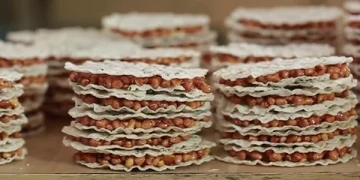
Rice paper
Typical in Hai Duong is the soft, chewy rice paper that won’t be crushed when soaked in water for a long time. People here reveal that they only use Q5 rice to have such rice paper. Customers who buy this specialty can be processed into delicious dishes such as stir-fried pork cooked with fish and chicken.