
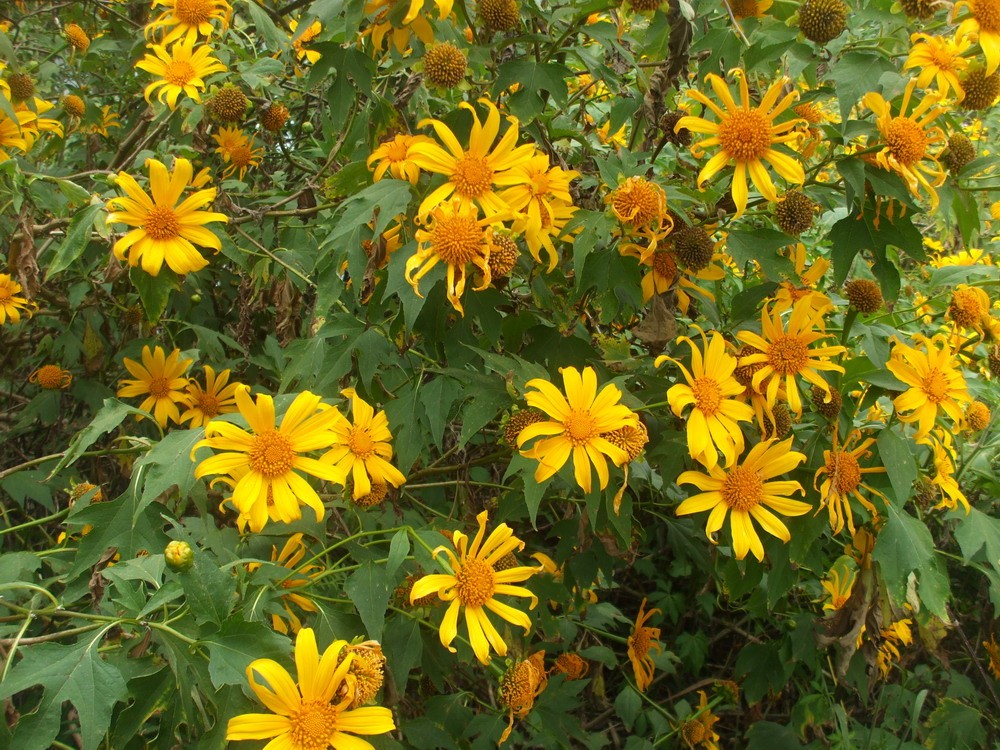
VietNamNet’s 12 October 2026 seasonal travel roundup lists Da Lat’s wild sunflowers among November attractions [8]. That is a reason to plan, not confirmation of this year’s blooms. The flowers—dã quỳ, also called cúc quỳ or sơn quỳ—are a roadside encounter rather than a single ticketed attraction. They grow in untidy, sunny clumps beside farmland, pine edges, slopes and minor roads. That is precisely why a good flower trip is flexible: you are looking for a landscape changing by elevation and rain, not arriving at one official field at a stated hour.
The seasonal pattern is well established but not a live 2026 forecast. A Vietnam National Authority of Tourism feature dated 18 November 2015 describes Da Lat’s cooler, drier period and recommends early morning light or the softer afternoon light around 3–4 p.m. [1] Tuổi Trẻ News reported a fuller 2023 bloom from late October to late November, while explicitly warning that prolonged rain can delay the season. [2] Those are useful boundaries and observation habits—not proof that flowers are open on 19 October 2026, or that the same roads will look the same this year.
Build the trip around uncertainty
The most resilient plan is two or three nights in Da Lat with one flower-focused day and a spare morning. Avoid a non-refundable, single-night “peak bloom” gamble if the flowers are the main reason for travelling. A stay in the city gives you the option to check a nearby stretch at first light, then change direction after a local update or a wet forecast.
Think in three decisions rather than one peak date. Before committing to a flower-led stay, ask whether any nearby stretches are showing colour. Before choosing a route, ask which of those places can be visited safely and lawfully. On the morning itself, decide whether the weather still supports the outing. A broad seasonal window cannot answer those questions for a particular hillside. Ask your accommodation or a reputable local guide what was actually visible in the previous few days; do not treat a social-media photograph as live evidence without a date and location.
Go early for dew, gentler light and less traffic on small roads, as the national tourism article suggests. Have a second look later in the day if cloud or rain spoils the morning, but do not turn “golden hour” into a reason to ride an unfamiliar mountain road after dark. Flowers are not worth a rushed return.
Choose a route by risk, not by a famous name
There is no single official 2026 sunflower circuit in this article. Older sources name several directions, and the route names may now be encountered differently after administrative changes. Lâm Đồng remains the relevant travel region for Da Lat, but do not assume every historic district label is a current official unit. Use current maps and local notices for today’s place names, access and road status.
A short city-edge loop is a conservative starting choice when the chosen road and stops have been checked locally. Ask locally about a nearby, publicly accessible road toward the flower-growing outskirts, go in daylight, and return before weather or visibility changes. This option produces a useful test: if flowers are sparse, you have lost a morning rather than a whole day. It also leaves time for a café, market or a booked attraction that does not depend on the bloom.
A western countryside day can connect the Cam Ly–Vạn Thành–Tà Nung direction with rural scenery. Tuổi Trẻ’s 2023 report identifies this broad path as a flower-viewing route and also mentions the old Cam Ly airport area and the Vạn Thành flower-growing area. [2] Treat those descriptions as historical reporting, not promises of open access. Farm tracks, private land, construction, traffic management and weather can change. Stop only where it is legal and safe; never walk into a crop, block a gate or pull onto a fast road for a photograph.
An eastern tea-and-hills day toward Trại Mát and Cầu Đất is another possibility when a local check says the flowers are showing. The 2015 national tourism article names the Cầu Đất direction among its suggested excursions, while Tuổi Trẻ describes the route as a way to combine flower watching with the tea-hill area. [1] [2] The journey is not a timetable or a guarantee. Confirm road conditions, daylight and the return plan before leaving; keep enough fuel, phone battery and water for an unscripted turn-around.
For a longer regional outing, only go with a driver or guide who can verify same-day conditions and understands the route. A private car is preferable to improvising on a motorbike if the group includes children, anyone uncomfortable on bends or travellers carrying camera equipment. If you self-ride, wear a properly fastened helmet, use a licensed vehicle, carry your driving documents and avoid riding in heavy rain. Do not use an expressway shoulder or stop on a bridge, bend or narrow pass to photograph flowers. A broad yellow hillside is never permission to cross a barrier.
Weather and road checks belong in the itinerary
Da Lat’s highland climate can turn a clear-looking morning into mist or rain. Check the forecast the evening before and again before departure; pack a light waterproof layer, warm layer, shoes with grip and a dry bag for phone and camera. Wet grass can conceal a steep edge, loose soil or a drainage channel. Stay on a visible path and ask before entering any field.
Use current, first-party information for closures, construction, traffic controls and attraction access. The national tourism authority’s Da Lat material is helpful for broad destination ideas, including outdoor areas, Tuyen Lam Lake and local food, but it is not a live road-status service. [3] Verify transport schedules and pickup details directly with an airline, bus operator, hotel or driver. This guide intentionally gives no fares, opening hours, transfer times or promised road distances: those details can change and would falsely imply a 2026 confirmation.
Plan a hard stop. If rain persists, visibility falls, a road is slick, or the driver says the route is unsafe, turn around. Replace the flower hunt with Da Lat’s central market, a café, a museum or a confirmed indoor visit. For a clear-weather alternative, the official tourism site suggests Tuyen Lam Lake, pagodas, coffee experiences and outdoor sites, but check each venue’s current access independently. [3] A flexible trip is not a failed trip when the flowers are late; it is a trip that has not made a fragile natural event carry the whole holiday.
Photograph the flowers without damaging them
Wild sunflower stems can be tall and dense, making a roadside scene look public even when the land behind it is not. Stay on the shoulder only where it is wide and safe, and ask permission for farm access or portraits. Do not pick blooms, flatten a verge, climb a roadside bank or create a new footpath. Avoid drones unless you have confirmed the applicable permission and local restrictions.
The strongest photographs usually need less intervention than visitors expect: backlight through petals, a person held well away from the flowers, or a road curve that provides scale. Early morning can bring dew and softer contrast; a hazy afternoon can give a gentler frame. Keep the lens pointed at the scene rather than at another visitor’s private moment, and remove location metadata when sharing a sensitive small field.
A practical three-day shape
Day one: arrive and calibrate. Settle in, check the next morning’s weather and ask a current local source where flowers were actually visible. Do not book a long excursion until you have that information. Walk the centre or visit a confirmed attraction so the day still works if the forecast deteriorates.
Day two: take the short route first. Leave after daylight, choose one direction, and keep a turnaround time. If the first stretch is sparse, do not chase a social post across unfamiliar roads. If conditions are good, stop at one or two lawful viewpoints and return for lunch. Leave the afternoon for a city activity or a second, nearby check in safe light.
Day three: decide, do not repeat. Use the spare morning for the route with the strongest current evidence, or switch to coffee, markets, lake scenery and food. If a guide or driver proposes a longer circuit, ask what is open, how the return works and what happens if rain arrives. Keep the plan cancellable until the forecast and road status are clear.
An optional guided countryside day
How this differs from the flower festival
Wild-sunflower season is a nature-timing story, not a festival ticket. If the flower festival is the reason for your trip, use the separate Da Lat Flower Festival planning guide and recheck the latest official programme. Its event planning is a different question from whether roadside flowers are blooming in October or November.
For broad, older orientation, the live Da Lat travel guide from A to Z was first published on 22 March 2020 and includes dated transport and attraction information; recheck its logistics. The Central Vietnam story archive is a useful regional index, but its stories are date-stamped and are not automatically current advice. The archive and guide are navigation aids, not substitutes for today’s weather, road and venue checks.