
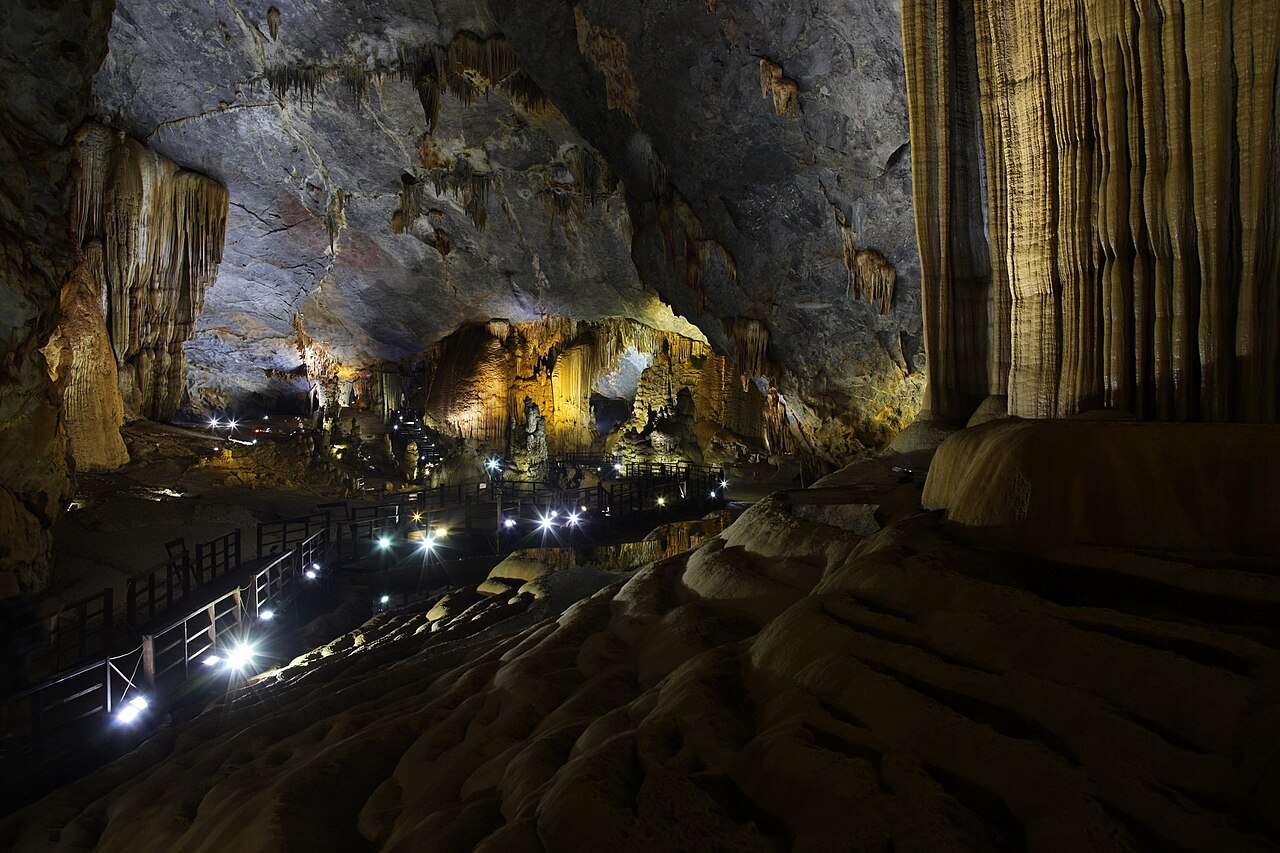
Short answer: Phong Nha can fit a Vietnam trip in November, but only if you treat the caves as a weather-dependent opportunity rather than the fixed centrepiece of your itinerary. November sits inside the region’s wet season. The Vietnam National Authority of Tourism warns that many caves are inaccessible from October to December, while a current tour listing can show what is sold without proving that your chosen cave will be open on your date. [1] [3] If missing the underground river would spoil the trip, use November for a different stop or add a flexible night. If you can enjoy karst scenery, village life and a slow-weather day even when a boat or trail is cancelled, Phong Nha is a reasonable gamble.
What November changes
November is not simply “rainy but still fine.” It is a month in which rain can alter the product itself: river levels can affect a boat approach, access roads can become unpleasant or unsafe, and operators may have to suspend a cave or adventure route at short notice. A useful climate reference describes September, October and November as Quang Binh’s heaviest-rainfall months and gives November an approximate monthly total of 270 millimetres. That is seasonal context, not a forecast for your week. [4]
The official tourism guide is more important for the decision than any tidy month-by-month average. It explicitly says many Phong Nha caves are inaccessible during the rainy season, defined there as October–December. It also distinguishes two very different visits: Phong Nha Cave is reached by river, while Paradise Cave is explored along wooden walkways after the land approach. [1] That distinction matters in a wet itinerary. “The caves are open” is not a sufficient answer unless you know which cave, which entrance, which transport and which water conditions.
There is also a risk of over-reading old travel advice. The same official guide includes historic bus fares, taxi prices and schedules. Those figures are useful as background to the geography, but they are not a November 2026 transport quote. Do not build a connection around an old hourly bus timetable or a remembered transfer price.
The landscape remains a strong reason to come. UNESCO’s current page describes the property as the transboundary Phong Nha-Ke Bang National Park and Hin Nam No National Park, extending across Vietnam and Laos, with more than 220 kilometres of documented caves and underground waterways. The page records a significant boundary modification in 2025. [2] That updated designation is useful context, but it does not mean every cave in the wider property is a public visitor site, or that a World Heritage label overrides local safety decisions.
The one-day plan: only for a movable schedule
A one-day Phong Nha visit works best when it is a spare day placed between more dependable transport segments, not when it is the one non-negotiable highlight of a tightly timed route. Arrive from Dong Hoi early enough to preserve daylight, choose one primary cave experience, and leave a second option only if the operator confirms it is practical that day. In wet weather, trying to stack several distant sites can turn a beautiful plan into a series of rushed transfers.
The most useful pre-booking question is not “What is your best cave tour?” It is: Which exact cave is operating on my date, what is the access method, and what happens if rain or water level stops it? Ask for the meeting point, final decision time, replacement itinerary, transport inclusions and refund terms in writing. If you are booking through a hotel or local desk, request the operator’s name and a receipt, not just a verbal assurance.
A current Klook listing is a useful illustration of the sort of product available in the market: it presents a nine-hour English join-in Paradise Cave and Phong Nha Cave day tour, optional hotel pick-up, a Dong Hoi meeting location, and a displayed 4.7/5 rating from 197 reviews with 2K+ booked. [3] Those are listing details observed on 7 November 2026, not a guarantee of availability, operating conditions, or the same package on your date. Treat the page as a lead. Confirm the actual date, package, pickup, inclusions and cancellation policy before paying.
If the river cave is suspended, a dry-cave visit may or may not be a valid substitute. Do not assume it is. Ask whether the replacement is a different cave, a park drive, a countryside route or a refund. If the answer is vague, do not pay a non-refundable deposit merely because the headline includes two caves. Optional cave tour: Check Paradise Cave and Phong Nha Cave Day Tour on Klook. The listing displayed 4.7/5 from 197 reviews when checked on 7 November 2026; a Full Day Tour selection for two adults on 14 November returned a positive quote. This is dated marketplace availability, not a cave-opening guarantee. The selected package states a minimum group of two, ages 5–60, no wheelchair access, and full cancellation at least 24 hours before the activity date. Extreme-weather cancellation permits another date or a refund under the listed terms. Recheck all conditions for your party. Disclosure: Say Hello Vietnam may earn a commission if you book through this affiliate link, at no extra cost to you.
The two-day plan: the better November compromise
Two days give weather a chance to move. A sensible structure is to sleep near Phong Nha on the first night, keep the main cave attempt on the more promising day, and reserve the other day for a lower-commitment combination of village roads, food, viewpoints or an operator-confirmed short walk. The exact alternatives should remain weather-led. A flooded trail is not a “backup” simply because it appears on a map.
Keep the schedule modular. Put the most cancellation-sensitive activity first if your onward transport is fixed, because a late cancellation leaves no recovery window. Put it second if your arrival day is the risky transfer. Either choice can be right; the correct decision depends on whether your priority is catching the cave or protecting the next train, flight or hotel night. Avoid booking an expensive multi-day expedition in November unless the operator has explained its weather protocol and your insurance covers the activity.
A two-day stay also makes room for a deliberate no-cave version of Phong Nha. The park’s value is not limited to a checklist of chambers. Karst ridges, wet-season vegetation, river scenery and quiet roads can still justify the stop, provided you do not promise yourself a particular photograph or boat journey. The official guide itself presents hiking, cycling and countryside routes as alternatives to caving, while also warning visitors to expect wet conditions on some paths. [1] In November, “alternative” should mean an option you can safely confirm, not an improvised trek into a closed area.
Dong Hoi or Phong Nha as your base?
Choose Dong Hoi when transport resilience matters most. It is the practical arrival point for the airport and railway, and it gives you a simpler exit if heavy rain disrupts the park. It also works for travellers who want a coastal city evening, a short stay before an early train, or a day trip with no commitment to sleeping in the countryside. Say Hello Vietnam’s existing Dong Hoi background guide is an older background guide dated 13 September 2021; use it for orientation, not current fares, schedules or live availability. [5]
Choose Phong Nha when the landscape and the possibility of a weather window are the point of the stop. Sleeping locally removes one return transfer, lets you ask accommodation staff for a same-day conditions update, and makes a second attempt more realistic. The trade-off is exposure: if roads, river access or tours are disrupted, you have fewer urban substitutes and may need to wait rather than pivot.
A hybrid is often the least stressful November arrangement: one night in Dong Hoi if your arrival is late or your onward connection is firm, followed by one refundable night in Phong Nha if the forecast and operator confirmation justify it. If you are booking two bases, check the cancellation deadlines separately. “Free cancellation” at one hotel does not protect a prepaid tour, a private transfer or a non-refundable second room.
The cancellation questions that actually matter
Before confirming, ask these questions in plain language:
- Is the booking for a named cave and date, or only for a general route?
- Who makes the closure decision: the park, the boat station, the tour operator or the guide?
- At what point before departure will you be told?
- If Phong Nha Cave is inaccessible, is Paradise Cave genuinely operating, and is transport included?
- If the whole tour is cancelled, do you receive a full refund, a credit, or a partial refund after transport and tickets?
- If you cancel because an official warning makes travel unsafe, what is the rule?
- Are hotel pickup, entrance tickets, boat fees, meals and transfers refundable separately?
- Can you move to the next day, and is that possible if the next day is already full?
- What happens if your arrival from Dong Hoi is delayed and you miss the meeting point?
Save the answers and the booking terms. A platform’s general cancellation badge may not answer weather-specific substitutions. For a join-in excursion, verify the meeting point twice: one listing may say “Dong Hoi city” while your accommodation is in Phong Nha, creating a transfer problem that rain makes harder.
A practical November decision rule
Go to Phong Nha in November if three things are true: you have at least one movable day, you are comfortable with a no-cave outcome, and the booking can be cancelled or changed after the operator’s weather decision. Prefer a two-day stay if the stop matters to you.
Skip or postpone it if you have a fixed flight or train immediately afterward, a non-refundable cave expedition, limited mobility that makes wet transfers especially difficult, or a Vietnam itinerary already full of weather-sensitive central-coast plans. The park will not be less meaningful because you chose a drier season.
As of 7 November 2026, I found no publicly verifiable, dated authority notice that guarantees November opening for a specific cave or package. That is not evidence of closure. It is a reason not to write “open daily” into your plan. Check the operator, accommodation and relevant park or ticket channel shortly before departure, then keep one realistic alternative. For wider central-Vietnam planning, see Say Hello Vietnam’s Central Vietnam archive; check individual story dates and verify any time-sensitive recommendations separately. [6]
Phong Nha in November is therefore a conditional yes. Make the rain part of the decision, not an inconvenience you hope the itinerary will ignore.
Fact-checked: 7 November 2026. Cave access, weather, transport and product availability can change; verify current conditions with the operator and relevant local authority before travelling.