
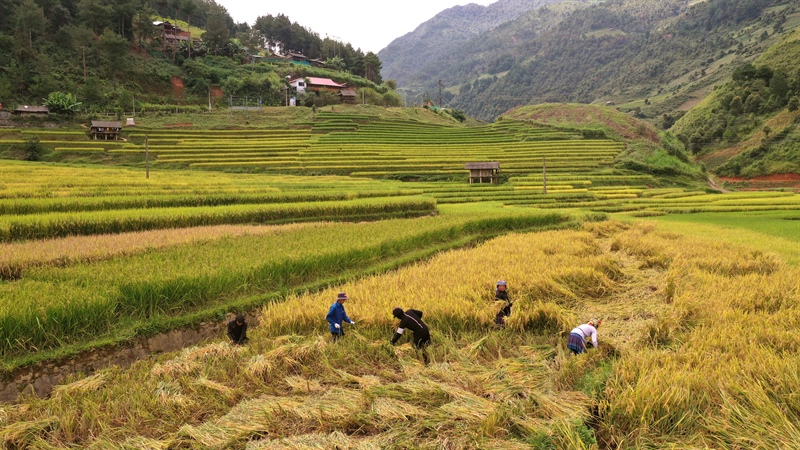
October is not a promise that every hillside will still be gold. It is the last stretch of Mù Cang Chải’s usual rice-harvest window, when one valley may be glowing while another has already been cut. If you are deciding whether to go now, plan around variable field conditions, mountain weather and a festival programme whose broad run is confirmed but whose day-by-day schedule must be checked locally.
Quick answer: Is October too late? Not necessarily. The official Lào Cai visitor guide gives late September–late October as the usual ripe-rice window, with timing varying by area; it does not confirm which fields are golden in 2026. If golden rice is your main reason to go, ask a local host for a recent, dated field update before booking.[1]
For the broader year-round overview of attractions, food and transport, see our Mù Cang Chải travel guide. This article focuses on late-season conditions and the 2026 festival. VietnamPlus/VNA’s 31 August 2026 report identifies the destination as Mù Cang Chải commune in Lào Cai province.[2] Older guides and maps may still use the former district/Yên Bái label, so give your accommodation the exact current address or map pin when arranging a transfer.
Is October too late to see golden rice?
Not necessarily—but the word “October” covers several different scenes. Lào Cai’s provincial visitor guide gives the usual ripe-rice period as late September to late October and explicitly says timing varies by area.[1] The national tourism site also describes harvest as generally falling in September and October, while noting that the mountain landscape changes across the year.[3] These are seasonal guides, not a field-by-field bulletin for 2026.
In practical terms, the same visit may include harvested plots, cut stalks drying, greener paddies at a different elevation and a few remaining golden slopes. That is not a failed trip; harvest is a working season, not a staged display. But if uninterrupted golden terraces are your only goal, late October is a riskier choice than the middle of the broad season. Before travelling, ask a current local host which areas still have standing rice on your intended dates. A recent photo with a timestamp and place name is more useful than an undated promotional image.
It is worth broadening the visual goal. Terraced hills remain striking after harvest: their curves, waterways, village paths and changing light are part of the landscape. The area’s appeal is not limited to one colour or a single overlook.
What the 2026 Golden Season Festival adds
Programme check — 12 October 2026: Vietnam News Agency reports that the Golden Season Festival runs through October. Its article lists activities, but does not provide a complete dated schedule. Check the latest notices from the Lào Cai Provincial Portal and ask your accommodation which events are confirmed for your exact dates.[2]
The festival opened in Mù Cang Chải commune on 30 August. The VNA overview names a Hmong flute performance contest, ethnic-costume displays, a beeswax-pattern activity, bánh dày pounding, street parades and a traditional market featuring local farm products, medicinal herbs and OCOP goods. It also reports the launch of a smart street with a digital tourism map.[2]
Treat that as a description of the programme, not a day-by-day timetable. Some activities may already have taken place by the time you read this. Do not book solely around a contest, parade or performance unless its date is confirmed. If no event aligns with your stay, the fields and villages remain the central reason to come.
Choose a small area, not a checklist of viewpoints
The Lào Cai visitor guide highlights landscapes around La Pán Tẩn and Chế Cu Nha, along with Mâm Xôi Hill, Móng Ngựa Hill and Khau Phạ Pass.[1] These names can help you discuss options with a local driver or host, but they are not a guarantee that every track is open, easy to reach or suitable for every vehicle. Local access arrangements and road conditions can change.
For a short visit, pick one cluster of viewpoints and villages rather than trying to collect every famous location. Ask what is accessible that day, how much walking is involved and whether the route is suitable after rain. A locally arranged driver can help with narrow or steep roads; if you are unfamiliar with mountain riding, do not assume a rental motorbike is the simplest way to reach a remote overlook. The best route is the one that lets you travel safely and spend time in the landscape, not the one with the most pins.
A flexible two-day plan
Day one: arrive, orient yourself and check conditions. Aim to reach your base with enough daylight to settle in. Ask your host for a current rice-and-road update, not only a generic “golden season” recommendation. Confirm the pickup point for the next morning, how long the local route takes today, and whether rain has changed access. If a festival activity is scheduled during your stay, ask whether it requires registration or a separate transfer. Keep the evening unhurried; a mountain trip can be tiring even before the sightseeing begins.
Day two: choose one landscape loop and leave time for village life. Start at the time your local host recommends for visibility and road conditions. Visit one or two nearby terrace viewpoints, then take a break in a village or local market rather than spending the whole day moving between photo stops. If rice is being harvested, observe from public paths or areas where visitors are explicitly welcome. Ask permission before photographing people closely, especially children and anyone working. Buy refreshments or local products directly from vendors where practical, and do not ask farmers to pause work or pose for a staged scene.
If the morning is misty or wet, ask your host whether the route is safe and whether visibility is likely to improve. A low-cloud day may still be atmospheric; a slippery hillside road is not worth a risky drive. Keep a lower-altitude or indoor alternative in mind, such as a local meal or a confirmed festival-market activity.
Add a third day if you want the trip to breathe
A third day gives you a buffer for weather and lets you see more than one part of the landscape without rushing. Use it for a second local area only if conditions and transport make sense. You might also look for a confirmed festival activity or a market selling regional products; the VNA report describes these as part of the 2026 programme but does not publish a full day-by-day calendar.[2]
Confirm opening, access, any local fees and the return plan before setting out, especially if your onward bus or flight connection leaves soon after the excursion. Keep the extra day flexible rather than filling it with fixed transfers.
Getting there without relying on stale schedules
Mù Cang Chải is a mountain destination, and travel times depend on route, weather, traffic and vehicle. Older tourism pages may state approximate distances or describe historic Yên Bái routes; use them for orientation only, then verify a current bus or private-transfer plan directly. Ask where the vehicle will drop you, whether the service reaches your accommodation, how luggage is handled and what happens if weather delays the journey. Avoid building a tight same-day connection around an assumed arrival time.
For local excursions, agree on the route, stops, return time and total cost before departure. If a viewpoint involves a steep path, ask about the surface and walking distance. Take drinking water, a light rain layer and shoes with grip; keep your phone charged and carry some cash in case card or mobile coverage is unreliable. These are practical precautions, not claims about the availability of any particular service.
Travel with the harvest, not over it
The terraces are both scenery and farmland, shaped by generations of local work. Stay on established paths, do not walk through planted or harvested plots unless invited, and never block a narrow road for a photograph. Ask locally and follow posted rules before flying a drone. Keep noise low near homes and places of worship, and do not treat traditional dress or cultural activities as a photo prop.
A good visit leaves more than a camera roll: pay for local transport or guiding when you use it, buy from small vendors and follow the host’s advice about where visitors are welcome. The festival report describes Hmong music, the new-rice thanksgiving ritual and beeswax textile patterns as part of a living community, not just an autumn backdrop.[2]
Should you go in October 2026?
Go if you are comfortable with an autumn landscape that may be partly harvested, want a highland setting and can keep your plans flexible. Consider a different date if a fully golden panorama is essential and you cannot verify current field conditions. The province’s broad late-September-to-late-October window and the festival’s October run make this a relevant time to ask—but not a guarantee of a specific view or performance.[1][2]
Before you leave, confirm what is still golden on your dates, which activities are actually scheduled, and whether your chosen road or viewpoint is accessible. That small check is more useful than a promise that the whole valley will look exactly like a photograph.