
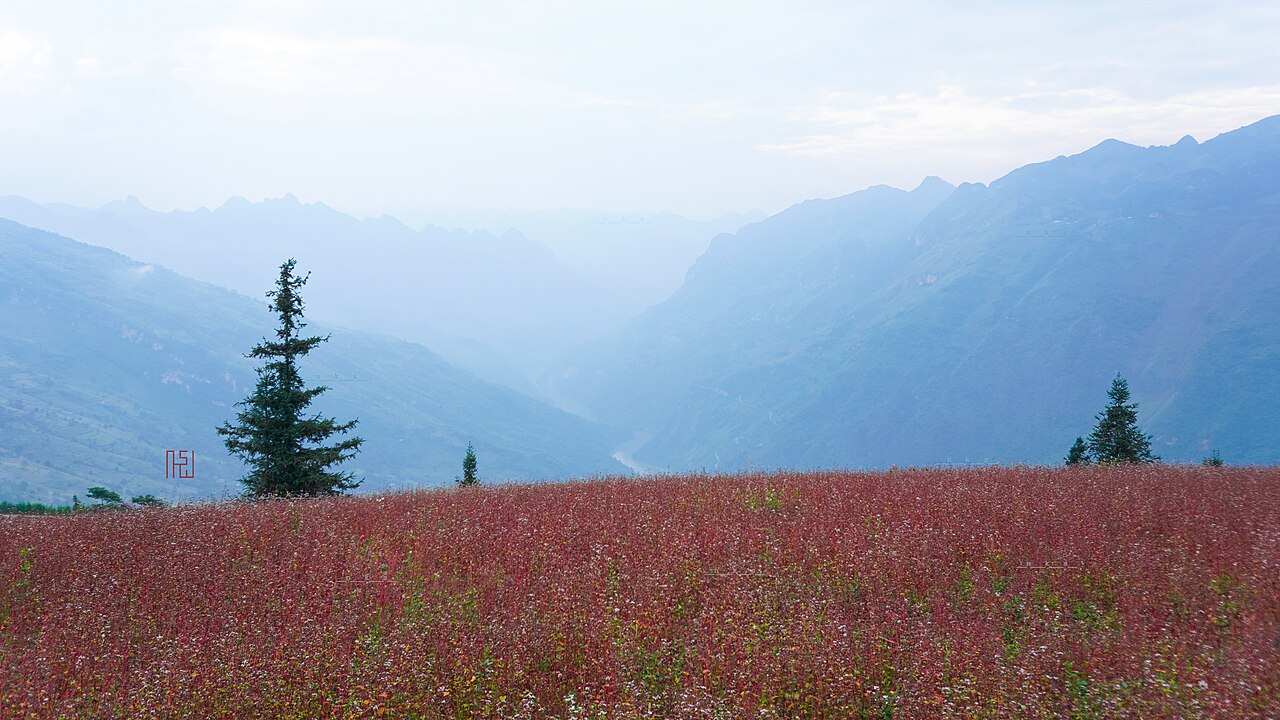
What October and November can—and cannot—tell you
Buckwheat is a crop before it is a photo subject. An official tourism report dated 4 November 2015 describes farmers using it as a cover crop after harvesting corn where arable land is limited.[6] VietnamPlus likewise explains that its grain-like seeds become regional foods.[2] A field is working farmland, not a permanent flower garden. Ask what stage a particular plot has reached rather than assuming every valley follows the same calendar.
The official Viet Nam National Authority of Tourism places the visible cycle broadly: white blooms arrive in late September, become pink as October moves into November, and are deep red by the end of December.[1] It also describes the display as running through October–December and says a festival typically falls in mid-to-late November.[1] Those are recurring seasonal descriptions, not a 2026 announcement. As of this fact-check on 18 October 2026, this article makes no claim about which fields are flowering now.
If you can choose only one part of the season, late October to mid-November is a reasonable planning target within the official colour-change window. The 2015 report specifically described late October to early November blooms; that is historical corroboration of seasonality, not proof of a 2026 peak.[1] [6] For an earlier or later trip, ask about named fields before committing. A flexible date and a recent report are more useful than a promise of a single “best week.”
Where to look without treating the plateau as one field
In this article, “Ha Giang” is the familiar travel-region name and refers to the former Ha Giang province area. National Assembly Resolution 202/2025/QH15 merged the former province with Tuyen Quang; the new Tuyen Quang provincial government began operating on 1 July 2025.[5] A useful flower plan follows the Dong Van Karst Plateau rather than one named garden. Vietnam Tourism highlights Thach Son Than, Lung Cam in Sung La Valley and Ma Pi Leng Pass as places where flowers meet the plateau’s karst scenery.[1] These descriptions indicate viewing possibilities, not confirmed 2026 plots or a ranked list. Use the official loop outline for broad road context, then ask a local host which accessible fields fit that route now.[4]
Sung La and Lung Cam suit travellers who want a valley composition with houses, cultivated land and limestone slopes. Vietnam Tourism places Lung Cam about 25 kilometres west of Dong Van and notes the connection with The Story of Pao.[1] The distance and flower coverage should be checked locally: roads, detours and cultivated plots are not static attractions with guaranteed displays.
The approach towards Dong Van is best treated as a flexible travel day rather than a single flower appointment. Leave room for a locally recommended stop that fits the road journey, but do not add an unverified detour merely because an old photograph looks attractive. For a first loop, avoid allocating only one short photo stop to the flowers: that makes the trip depend on one field being accessible and in bloom.
Ma Pi Leng and Meo Vac add dramatic road scenery, but roadside photography needs more discipline. The official loop guide urges caution on mountain roads.[4] Stop only where you are fully clear of traffic, never stand in a live lane for a photograph, and do not ask a driver to halt on a bend. Let the driver choose a safe stopping place rather than reacting suddenly to a view. The flowers are not worth turning a scenic stop into a road hazard.
A practical three- or four-day shape
For a first flower-focused visit, allow enough time for conditions to change.
Day 1: Ha Giang City to Yen Minh. Reach Ha Giang City from Hanoi, settle your transport and use the first riding day to cross towards Quan Ba and Yen Minh. It is the practical road gateway for this itinerary. The official destination profile gives broad access context—around 300 kilometres from Hanoi, with buses taking roughly six hours depending on vehicle and driver—but its “provincial gateway” wording predates the 2025 reorganisation.[3] [5] These are not live timetable facts. Avoid planning a long mountain ride immediately after an overnight transfer.
Day 2: Yen Minh to Dong Van, with flower checks. Use the QL4C route towards Pho Cao, Sung La and Dong Van, stopping at fields only with permission. If a recently checked plot is not flowering, ask your host or guide for another location by name and date. Keep Sung La, Lung Cam and the Lung Cu road as options, rather than promising all three in a tightly timed schedule.
Day 3: Dong Van to Meo Vac via Ma Pi Leng. This is the day for the pass and the Nho Que landscape, with flower stops only at safe pull-offs. The official four-day route guide describes Dong Van to Meo Vac as a 24-kilometre stretch that can take most of a morning once viewpoints are included.[4] Do not turn that published route outline into a guaranteed travel time: traffic, weather, roadworks and stops change the day.
Day 4: Return to Ha Giang City. The official loop outline returns via Bao Lam and Bac Me on QL34.[4] If you have only three days, shorten the route with a current local operator rather than trying to combine every pass and side trip. Public transport across this mountain region is limited, and Vietnam Tourism recommends an experienced rider or a tour by motorbike or private car for the mountain roads.[3]
Respect the crop and the people who grow it
Remember the crop’s food value, documented by VietnamPlus, while enjoying the flowers.[2] Ask before entering any plot, stay on paths, do not trample rows for a better angle, and do not pick flowers. If a field has an entrance or local attendant, follow the posted instruction and ask for the current contribution or photo rule. This article deliberately gives no field fee because older reports list historical prices that cannot be treated as current.
Photograph people as people, not as scenery. Ask before making a portrait, especially of children, and accept a refusal. Do not move baskets, tools or crops to stage a picture. Buying a local snack or crop product can be a respectful exchange, but it does not buy access to a home or permission to photograph someone.
Transport, weather and safety checks for 2026
Do not rely on an old fare, bus departure or rental rate. The site’s evergreen Ha Giang sights guide was published on 22 March 2020. It remains useful for its historic overview of places such as Sung La, Ma Pi Leng and Dong Van, but its “best time,” Hanoi distance, transport advice, and any route or price details should be rechecked before booking. The site’s North Vietnam archive also lists the older early-autumn Ha Giang story, published 13 April 2020; it describes seasonal scenery and a classic loop, not 2026 field conditions.
The official destination page calls September–November a good period for cooler temperatures.[3] That is climate guidance, not a forecast. Check the short-range forecast before each riding day and ask locally about rain, fog, landslides, construction and visibility. Pack layers, waterproof protection, gloves and footwear with grip. Mountain weather can make a viewpoint disappear even when a field is flowering.
If you ride, check the paperwork before choosing a motorbike. For UK licence holders, the UK government’s Vietnam travel advice specifies a 1968 International Driving Permit together with the home driving licence, and says third-party insurance is required; it also warns that travel insurance must cover the planned motorbike activity.[8] Travellers with other licences should check the rules applicable to their documents. Requirements and insurer terms can depend on the vehicle and licence category, so confirm the current rule with the relevant authority and your insurer rather than assuming a licence issued elsewhere is enough. Carry the original documents and emergency contact details, and confirm who handles roadside assistance before departure. A reputable operator, a properly fitting helmet and a bike inspection are more useful than squeezing in another viewpoint. If you are not an experienced rider, choose a car with a driver or an established guided trip instead.
What to verify shortly before leaving
One week before departure, ask your accommodation or a locally based guide for recent, location-specific updates: the field name, the date of the photo or report, road access and whether visitors may enter. Compare at least two recent updates rather than trusting a recycled annual caption.
Also verify any 2026 festival announcement through an official Ha Giang or local authority channel. The official tourism article’s mid-to-late-November wording is historical recurring guidance, not an event booking notice.[1] Do not book transport around an unverified festival date, and do not assume a named field charges the amount shown in a much older article.
The right expectation is not “Ha Giang will be pink on arrival.” It is a road trip through a changing agricultural landscape, with a good chance of finding blooms if you spread your stops, protect the crop and let current information adjust the route.